NH Fish and Game Director of Fisheries Dianne Timmins guests on Reel Northern Bass Talk Livestream...
“Smaller bugs equals smaller fish...”
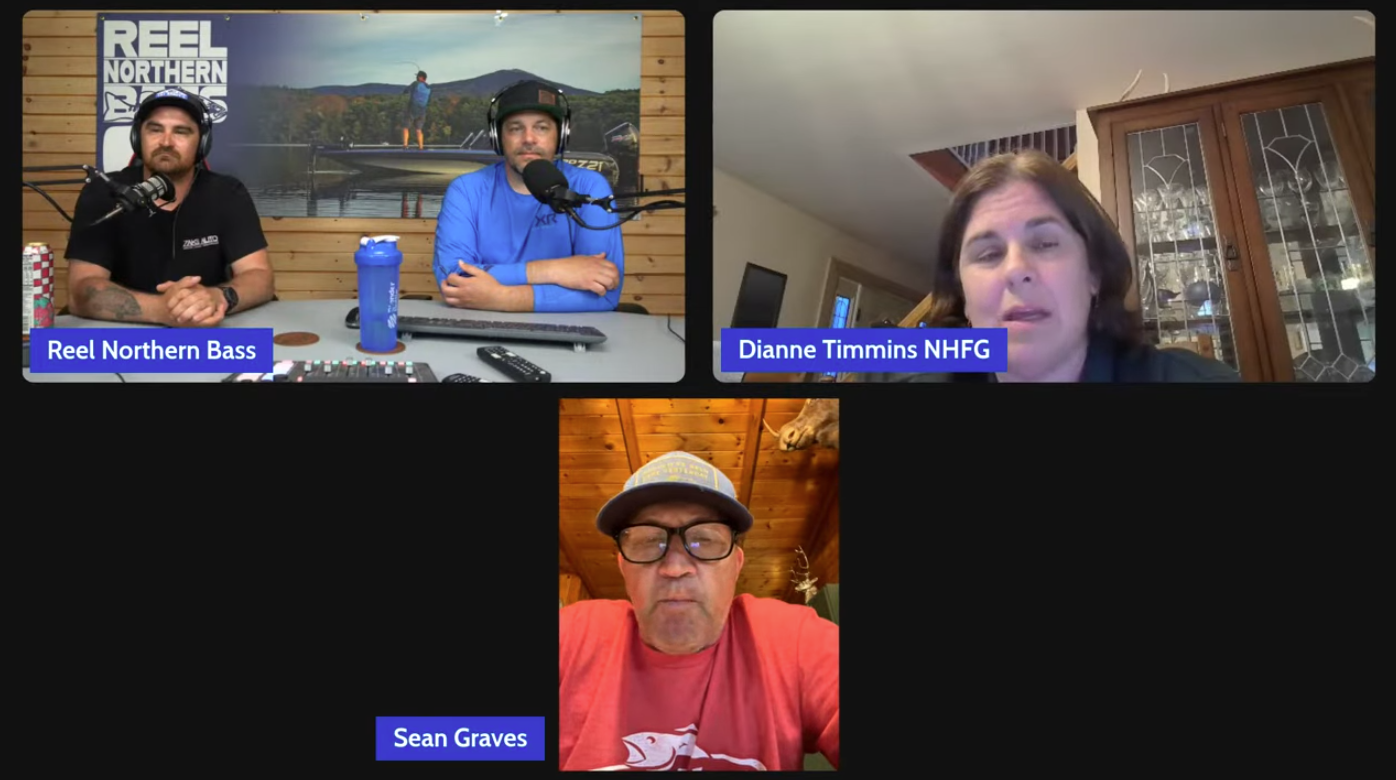
New Hampshire Fish and Game Director of Fisheries Dianne Timmins recently guested on Reel Northern Bass Talk Livestream. Bass are nonnative to New Hampshire, and considered highly invasive to wild native brook trout.
One thing Timmins discussed was her recent proposed rule changes for NH's designated Trout Ponds. While sold as a way to increase “opportunity,” many of the proposed changes put wild native brook trout and aquatic habitats at risk of nonnative fish introductions.
The biggest concern regarding Timmins recent trout pond regulation change proposal is a notable increase in the allowance of live fish as bait. This is contrary to what is happening in other states, including neighboring Maine, that are taking steps to restrict where live fish as bait can be used.
Below are some statements that should concern you if you want to preserve healthy aquatic ecosystems and wild native fish. You can jump to the specific point in the podcast by clicking the time link above the quote:
“Stocking is always going to be a part of New Hampshire. It’s basically part of our granitic soils. We don’t have calcium. Because we don’t have calcium, we have small bugs. Bugs really need calcium for their exoskeleton development. So our neighboring states, we have a lot more granite. And as a result, not a lot of calcium and limestone. And so as a result, we have smaller bugs. Smaller bugs equals smaller fish. And so on and so on. And so as a result, stocking will always be a component because I know a lot of folks um really like those larger fish that we can put in.”
While stocking is not going away any time soon, the statement above is concerning as it is used to defend what is really a social issue: The desire for bigger fish than what Mother Nature provides. It also ignores the fact that much of what NH stocks are nonnative rainbow and brown trout, so it’s not just about size.
Just because anglers want something doesn’t mean that NHFG has to provide it. I and others want wild native brook trout in natural abundance and size distribution, but NHFG refuses to provide that even though it would cost them noting. Conversely, when anglers want more and larger stocked fish, NHFG provides it.
The idea that “Smaller bugs equals smaller fish” is misleading. Trout grow large on a diet of midges in places like Lees Ferry in AZ, San Juan River in NM, other tailwaters, spring creeks, and reservoirs. And “large” in regard to fish is subjective as it is very much tied to the size of the stream, length of the growing season, etc.
Brook trout are opportunistic feeders, especially in small freestone streams where most wild native brook trout in NH are found. They feed on minnows, including juvenile brook trout, and terrestrial insects that wash into or fall into the water from the banks and canopy. Ants, beetles, bees, caterpillars, and worms are available to NH brook trout for at least half the season.
And to be clear, while not what I would call robust, we often encounter mayflies, caddis, and even stoneflies on many NH waters…
The reason why NH’s wild native fisheries are underachieving has a lot to do with angler exploitation. Most are managed under General Law regulations which allows anglers to keep 5 fish a day of any size, and use bait which comes with a 30% incidental mortality rate by most definitions.
While Timmins has referred to angler harvest as “compensatory,” not additive, when asked why she was stocking over wild native brook trout in Echo Lake in Franconia and the lower Wildcat River in Jackson, she said it was to offset angler harvest.
As a regular NH stream fisherman, I typically don’t start fishing until well away from the road due to what are usually low numbers. Conversely, once I get beyond the crowds I encounter fish in solid numbers and in sizes larger than what Timmins says are there.
When the discussion turned to introducing nonnative pike and walleye, including using the former to control nonnative rock bass, Dianne did not challenge the general idea beyond questioning where they would and would not do well. Clearly, there was a dangerous lack of negative messaging here.
Timmins’ general message was “Increased opportunity.” This includes removing the live fish as bait restriction from designated Trout Ponds. Today these waters allow the use of worms, salmon eggs, synthetic bait, lures, and flies. Will the inclusion of live fish as bait increase usage? And is it worth the biological risk?
While Timmins states that all minnow species allowed as bait are native to the state, that is not the case with regard to Emerald shiner (Notropis atherinoides) according to both USGS and USFWS. They are also known to carry VHS a highly contagious disease that is fatal to many fish species.
Per NHFG, creek chubsucker are “…are relatively common south of the White Mountains.” Unfortunately, many of the ponds that will lose their live fish as bait restriction are in or north of the White Mountains.
If taken at face value, “Killifish/tomcod (Fundulus sp.),” where “sp” equals species, this includes native banded killifish (Fundulus diaphanus), as well as nonnative Plains killifish (Fundulus zebrinus), Gulf killifish (Fundulus grandis), Seminole killifish (Fundulus seminolis), and California killifish (Fundulus parvipinnis.) As for tomcod, or Atlantic Tomcod (Microgadus tomcod,) I suspect they mean mummichog (Fundulus heteroclitus,) a form of killfish that inhabit brackish water and saltwater.
According to USGS, silvery minnow (Hybognathus nuchalis) are nonnative east of the Mississippi River watershed. Even if NHFG means Eastern silvery minnow (Hybognathus regius,) they are only native to the Connecticut River watershed. This means they are not native to the Androscoggin River, Saco River, or Pemigewasset/Merrimack River watersheds.
Similar to Eastern silvery minnow, spottail shiner (Hudsonius hudsonius,) are only native to the lower Connecticut River watershed. This means they are not native to the upper Connecticut River, Androscoggin River, Saco River, or Pemigewasset/Merrimack River watersheds.
Rainbow smelt (Osmerus mordax,) a popular bait species with anglers, are native to only a handful of waters in New Hampshire. Smelt are considered invasive to brook trout, and especially so in regard to smaller lakes and ponds.
White sucker (Catostomus commersonii,) are considered invasive to brook trout, and highly so in regard to smaller lakes and ponds. Maine has successfully undertaken white sucker removal programs to bolster wild native brook trout population in small ponds.
Then there is the issue of species misidentification associated with self-trapped bait. Many anglers, and even biologist, struggle to tell the difference between minnow species and may inadvertently introduce nonnative invasive roughfish or even gamefish such as sunfish and bass.
Timmins admits that not all legal baitfish species are native to all of the waters they can be used on. In many cases they are not currently present in a given water. Timmins fails to mention that baitfish released in one pond can negatively impact its tributaries and other ponds due to outmigration. Unfortunately, Timmins ignores or downplays the potential impact of future baitfish introductions.
Clearly, NHFG and Timmins need to do some housecleaning in regard to their legal to use as bait list and the use of live fish as bait in general as the proposed expansion is counter to what most states are doing…
“So Cold Water right now is leading the ship for sure. We’d like to change that...”
This statement is particularly concerning as New Hampshire is very much a coldwater fishery state. In fact, the state likely has the most robust wild native brook trout small freestone headwater stream inventory in New England. Timmins position not only ignores the ongoing spread of nonnative warmwater fish, but it encourages it.
As nonnative warmwater fish species continue to spread, low elevation waters continue to warm, and more habitat is degraded by epic floods and ill-advised mitigation efforts in the east, New Hampshire’s high elevation steams will become increasingly important in regard to maintaining wild native brook trout in the future.
“I mean, bass anglers, bass are the number one sought after species now. They took over trout. You know, I think the survey was four four years ago, I think, at this point, and so, it it basically that’s the scenario. You know, we’re finding that there are a lot more bass anglers out there than there are trout anglers. And so, you know, it’s my obligation to appeal to all user groups.”
While Timmins is likely correct that there are more bass anglers than trout anglers in New Hampshire, the fact remains that bass are not native to New Hampshire and they are highly invasive to not only wild native brook trout, but native minnows, roughfish, and warmwater gamefish as well.
Encouraging the promotion of nonnative fish is encouraging the proliferation of nonnative fish. Maine went through this a decade ago, but were pressured into removing protective regulations from pike throughout the state and bass in the trout rich North Zone.
Summary
While much of what Timmins is proposing puts wild native fish at risk, there is virtually nothing in her latest proposal that provides added protection to the states wild native fish…