Moving the Ball, But Stopping Short of the Goal Line...
Bob Mallard - Executive Director, Native Fish Coalition
While NFC’s organizational focus is on wild native fish and aquatic ecosystem conservation, as a freelance writer I cover a lot of different things at a personal level. Although most of my writing mimics NFC’s focus, once in a while I address things such as tackle and gear, travel, and even public safety and human health.
In June of 2024, I had an article published in the Bangor Daily News (BDN) about Maine Department of Fisheries and Wildlife (MDIFW) stocking waters contaminated with PFAS, otherwise known as “forever chemicals” with trout. The article was part of a regular column I had at the time.
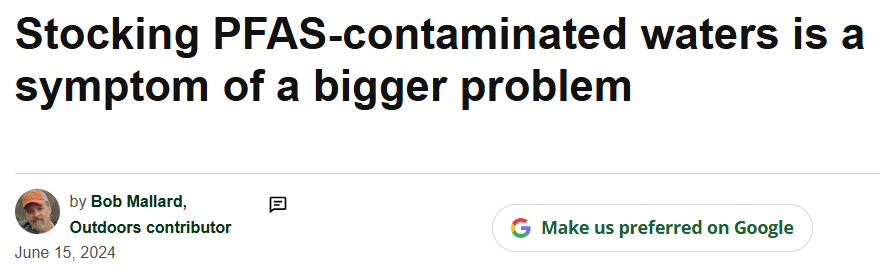
From the original BDN article on MDIFW stocking PFAS contaminated waters with trout…
The impetus of the article was a small pond open to fishing to children only. In addition to stocking the fish for kids to catch, there was no restriction on harvest. Children could harvest up to 5 fish a day. While most fish likely get caught or die soon after stocking, we don’t know enough to say that eating them does not pose a threat to public health.
Not only could children eat fish they caught from the pond, they could bring them home to others to consume or give them away to unsuspecting people who could eat them. And to be fair, we can’t expect children to understand the risks of something as abstract as PFAS.
The article was written and published at a low point in NFC’s and my personal relationship with MDIFW. Communication between NFC and MDIFW and MDIFW and me were strained at best. But MDIFW was made aware of the concerns noted in the article at the time. Unfortunately, they chose not to act.
Below is the unedited text for the original article. While I no longer write for the BDN due to censorship from the new Outdoor Editor Sue Bard, a former MDIFW employee, who only wants to run feel-good pieces, my historical articles are still online, albeit behind a pay-to-read firewall:
Stocking PFAS Contaminated Waters: A Symptom of a Bigger Problem…
Someone recently forwarded me an article about Maine Department of Inland Fisheries and Wildlife stocking trout in contaminated water. While it covered a lot of ground, the underlying message was clear: The problems with stocking are many and varied.
While more about fishing and public safety than fish conservation, my primary focus, stocking trout in contaminated water shows just how deeply engrained the stocking culture is at MDIFW, and how it can impact our environment and lives.
The focus of the article was small kids-only fishing ponds in Fairfield that are contaminated with PFAS, or what are known as “forever chemicals.” Fairfield is ground-zero for PFAS contamination in Maine, and these ponds are said to be some of the most polluted waters in the state.
The contamination is bad enough that the state posted signs warning anglers not to eat any fish from the ponds. Unfortunately, the signs are said to be missing or difficult to read. That one agency stocks fish and another tells the public not to eat them shows a major disconnect.
Maine has a culture of fish consumption, especially in regard to brook trout, the species stocked at the kids-fishing ponds. For many Mainer’s, freshly caught brook trout are both a delicacy and rite of passage. Whether the fish are stocked or wild is often irrelevant.
MDIFW regularly promotes harvest, and by default the consumption of trout, as a way to “improve” fisheries and best utilize the resource. They do so on their website, newsletter, and signs posted at high-traffic areas such as the L.L.Bean flagship store in Freeport:
“…but otherwise, you can decide which legally harvestable fish to keep for consumption… Many fishing regulations are designed to improve fish growth and size quality, and they are only successful if fish are harvested by anglers.”
In the case of the PFAS contaminated Fairfield kids ponds, MDIFW allows anglers to legally harvest up to 5 fish a day. A note at the bottom of the water-specific regulation for the ponds states, “(See Fish Consumption Advisories on page A-4)” The water-specific warning says, “Do not eat any fish from these waters.” If it’s not safe to eat the fish, anglers should not be allowed to harvest them.
While these ponds are referred to as “Fairfield Recreational (PAL) Ponds” on the Maine Inland Fishing Laws book (print and online) and related online Special Fishing Laws, they are called “Police Athletic League (PAL) Ponds” on the fish-consumption advisory section of the law book. While those who live in the area may know they are one in the same, will those unfamiliar with the area know?
Should we expect children under 16 to read signs or reference the lawbook for fish-consumption advisories? Even if they do, will they heed the advice and forgo bringing a few fish home for dinner, or might they ignore the warnings and consume the fish or give them to some unsuspecting relative, friend, or neighbor to eat?
Making matters worse is a quote in the article from MDIFW that downplays and even challenges the dangers of PFAS:
“In an ideal world, yes, we’d put the fish where there are no health issues, but there’s still a lot we don’t know about PFAS...”
Another quote attributed to MDIFW likens eating a PFAS contaminated fish to consuming too much barbeque, while putting it back on the angler, which in this case is children under 16 years old. And if a kid eats one PFAS contaminated fish, they are very likely to eat multiple contaminated fish:
“Consumption advisories are just that, advisories... Is eating one contaminated fish any worse than eating too much barbecue? People have to use their own judgment...”
The Fairfield kids ponds are not the only PFAS-contaminated waters in Maine stocked with trout. Out of 12 waters listed by MDIFW as contaminated with PFAS, 7-8 are being stocked with trout. Of these, four suggest that you do not consume more than 3-4 “meals” of trout a year, while the Fairfield kids ponds suggests you eat no fish at all.
Another MDIFW list warns anglers against consuming fish from waters contaminated with PCBs, Dioxins, and DDT. Of the 14 entries, at least 5 are being stocked. Consumption warnings range from no more than 5 to 24 meals a year, the worst of which is the popular Shawmut stretch of the Kennebec River.
With the exception of the uppermost section of the Androscoggin River, all of the contaminated stocked waters are open to the harvest of fish. In all cases, the legal daily limit when compounded over multiple days far exceeds that recommended in the associated fish consumption advisory.
MDIFW is responsible for the decision to stock trout in the Fairfield kids ponds and other contaminated waters. They are also responsible for allowing the harvest of fish from contaminated water. Like when they stock over wild native fish or stocks nonnative species, placing a higher value on stocking than environmental health, in this case MDIFW is placing a higher value on stocking than human health.
Stocking contaminated waters and allowing anglers to harvest fish at a rate that exceeds the published fish consumption advisory is risky. Getting harvest limits in line with consumption advisories would be prudent. In extreme cases, it may be best to suspend stocking and close the water to fishing.
MDIFW Acknowledges the Problem
Two years after the article was published, MDIFW is taking action and placing a catch-and-release regulation on the pond for all species of fish. While stocking should be suspended to eliminate the temptation to eat potentially contaminated trout, it is a step in the right direction.
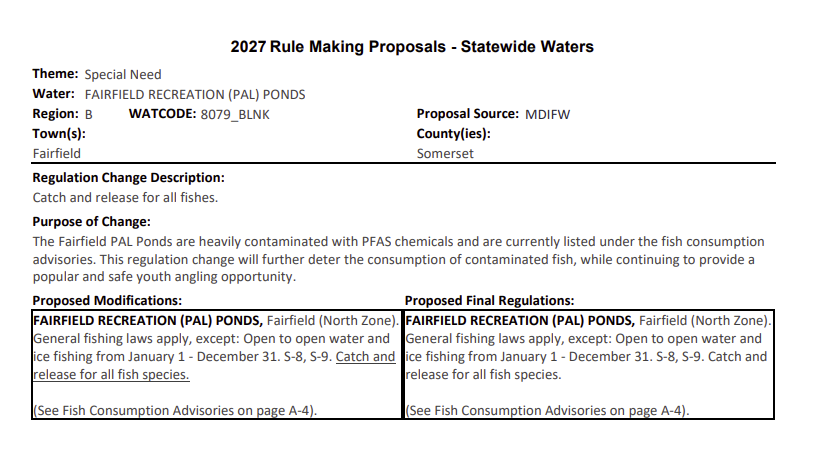
From MDIFW fishing regulations change package…
“Purpose of Change: The Fairfield PAL Ponds are heavily contaminated with PFAS chemicals and are currently listed under the fish consumption advisories. This regulation change will further deter the consumption of contaminated fish, while continuing to provide a popular and safe youth angling opportunity...”
Unfortunately, as often is the case the flawed belief that trout should be unlimited has trumped all, including public safety. Like many state fish and game agencies, MDIFW has convinced themselves that “angling opportunity” means fishing for stocked trout.
We still have a long way to go in regard to bringing science, fiscal responsibility, and public safety into state level fisheries management. It’s a long game where wins are far fewer than losses, and often delayed for years even when the prudent path forward is clear and clearly documented…